
B2B Marketplace Platforms
Multi-vendor architectures for industrial supplies, wholesale and service platforms
What distinguishes a B2B marketplace from an online shop
A B2B marketplace is not an online shop with multiple products. It is a platform where independent vendors offer their goods and services to buyers - with their own catalogs, their own pricing and their own branding. The platform itself is an intermediary, not a seller. This creates entirely different requirements for architecture, payment processing, contract structures and operational processes. Elasticbrains has been building platforms for industrial supplies, logistics and B2B services since 2015 and knows the technical and regulatory pitfalls from practical experience.
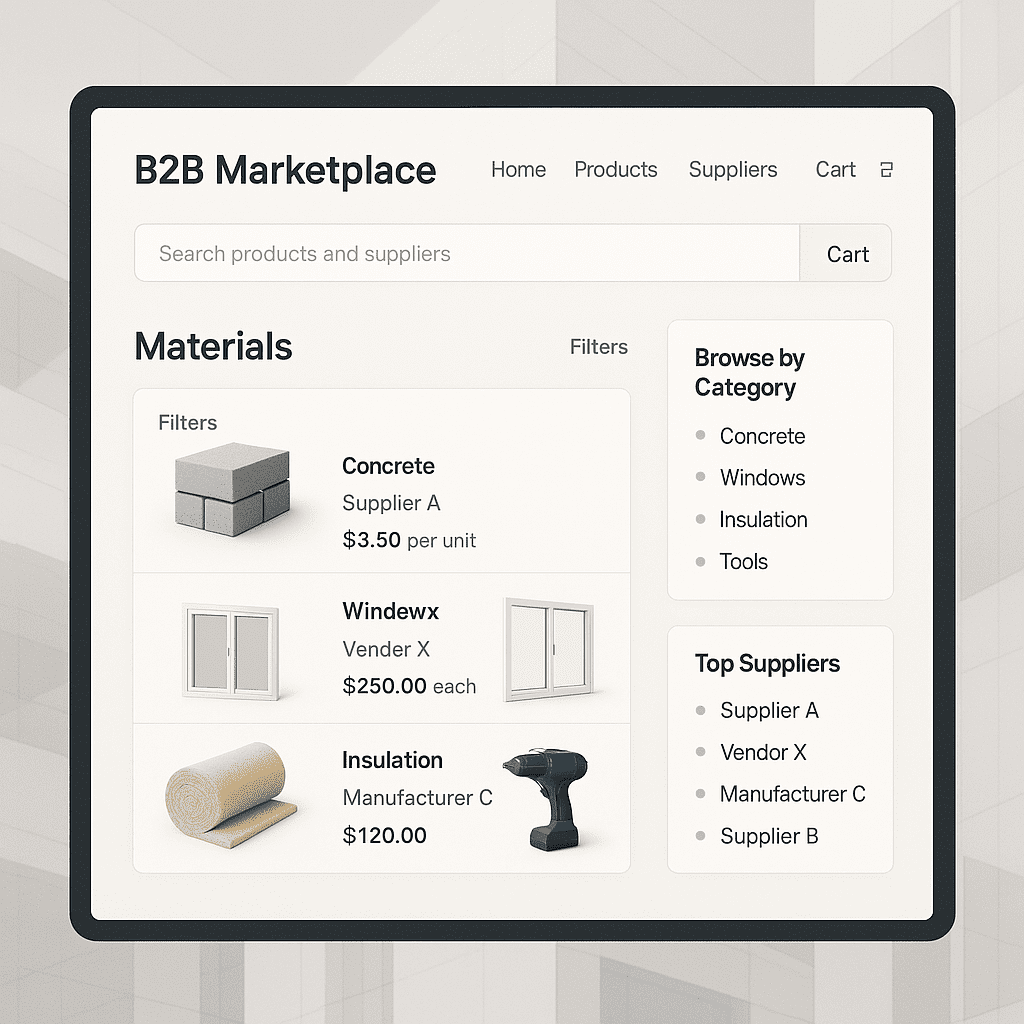
Distinction: marketplace, shop and vendor portal
Before diving into architecture, it is worth distinguishing between three related concepts:
B2B Marketplace (this page)
Many independent sellers on one platform. The platform provides infrastructure, earns commissions, and governs payment flows and contractual relationships between buyers and sellers.
Classic online shop
One vendor sells to many buyers. Simpler architecture, no vendor isolation, no split payments. If you need a classic B2B or B2C shop, you will find all information under E-Commerce Solutions.
Vendor onboarding portal
Structured onboarding and management of individual sellers on your platform, including contract management and approval processes. Details can be found under Seller Management.
Classic online shop instead of marketplace?
If you need an online shop with one vendor and a clear one-to-many customer relationship, our E-Commerce Solutions are a better fit. Marketplace architecture involves considerably more complexity and only makes sense when multiple independent sellers are genuinely intended to operate on a shared platform.
View E-Commerce Solutions →Core functions of a B2B marketplace platform
The following modules form the technical backbone of a professional B2B marketplace:
Multi-tenant architecture
Each vendor receives an isolated environment with its own product catalog, inventory, pricing rules and access rights. Data separation is not just a UX requirement, but a legal necessity.
Vendor onboarding and approval workflow
Structured process for accepting new sellers: document verification, KYC procedures, contract signing, product review and approval. Configurable according to industry requirements.
Product approval workflow
Each new product and every price change by a vendor can be reviewed and approved by a platform editor before it becomes visible in the marketplace. Prevents quality loss and protects platform integrity.
Commission models and billing logic
Flexible commission structures: percentage-based, category-specific, volume-dependent or flat rate. Automatic calculation, display in vendor statements and export to accounting systems.
Split payments and escrow transactions
Payments flow from the buyer to an escrow account. After delivery confirmation, the payment is automatically split: the vendor receives their share, the platform retains the commission. Technically implemented with Stripe Connect or Mangopay.
Rating system and dispute resolution
Structured feedback on delivery reliability, product quality and communication. Integrated dispute settlement procedure with defined escalation levels and processing deadlines.
Anti-disintermediation mechanisms
Structural and contractual safeguards that prevent buyers and sellers from processing transactions outside the platform - including monitoring and warning systems.
Search algorithm and ranking
Elasticsearch-based product search with vendor-weighted ranking, relevance scoring and category-specific filters. Optional sponsored placement for vendor visibility.
Technology stack for B2B marketplaces
We rely on technologies proven for platform scaling and regulatory requirements:
Industries and use cases
B2B marketplaces emerge in very different industries. Our experience includes:
- Industrial supplies and MRO: Spare parts, consumables and technical equipment from multiple specialist dealers on a single procurement platform. Typical for manufacturing and process industries.
- Wholesale platforms: Multiple wholesalers offer resellers and buyers access to their product range via a shared digital interface with unified ordering logic.
- Logistics marketplaces: Freight offers, warehouse capacity or transport services from multiple providers brought together in a single booking platform.
- Service platforms: Consulting, inspection or maintenance services from qualified providers via a structured brokerage platform with standardised service descriptions.
Our project approach
- Platform scoping: We clarify business model, vendor relationships, payment flows and regulatory requirements (KYC, AML, contract law). Result: binding feature set and architecture decision.
- Architecture design: We define the data model, multi-tenant strategy, integration points (ERP, payment provider, identity verification) and deployment architecture.
- MVP development: We develop a working MVP with core vendor onboarding, product catalog, checkout and basic billing - ready for first vendor pilots.
- Vendor pilot phase: Onboarding of 3-5 pilot vendors, feedback loop on onboarding processes, product data and billing logic. Iterative improvement before public launch.
- Scaling and operations: Expansion with additional vendor classes, commission variants, reporting dashboards and operational automation. We accompany your platform beyond the launch.
Vendor onboarding and management
Structured onboarding of new sellers, management of vendor profiles and control of access rights is a topic in its own right. Our Seller Management solutions describe how we map vendor lifecycles from application to termination.
View Seller Management →Frequently asked questions about B2B marketplaces
How much does it cost to build a B2B marketplace?
A first working MVP with vendor onboarding, product catalog, checkout and basic billing typically falls in the six-figure range. Exact costs depend on the number of vendor types, payment requirements (escrow yes/no), integrations (ERP, KYC providers) and industry specifics. We provide a binding quote after a scoping call.
Which payment provider is suitable for B2B marketplaces?
For split payments and escrow transactions in Europe, Stripe Connect and Mangopay are the most reliable options. Both are specifically designed for platform models and comply with PSD2 requirements. The choice depends on transaction volume, currency requirements and the desired degree of platform control.
How long does development take until first vendor onboarding?
A realistic timeframe for an MVP through to first vendor pilots is 4-6 months, depending on scope and integration effort. Full marketplace functionality including reporting, dispute resolution and automation is typically achieved after 9-12 months of development.
Does my marketplace need to meet KYC and AML requirements?
As soon as your platform intermediates payment flows between third parties, regulatory requirements come into play. The extent depends on the payment model, the platform's registered location and the parties involved. We address these questions during scoping and recommend suitable KYC providers and payment processors that bring regulatory compliance with them.
Can we start with a smaller scope and expand later?
Yes - but only if the architecture is designed for it from the start. Retrofitting multi-tenant architecture into a monolith is costly. We recommend building on scalable data separation and modular commission logic from the MVP onwards, so that extensions can be added incrementally without restructuring.
Ready for Your Project?
Let us clarify in a non-binding initial conversation how we can best support you.
Free · No obligation · Personal initial consultation by experienced Munich experts